
Summary:
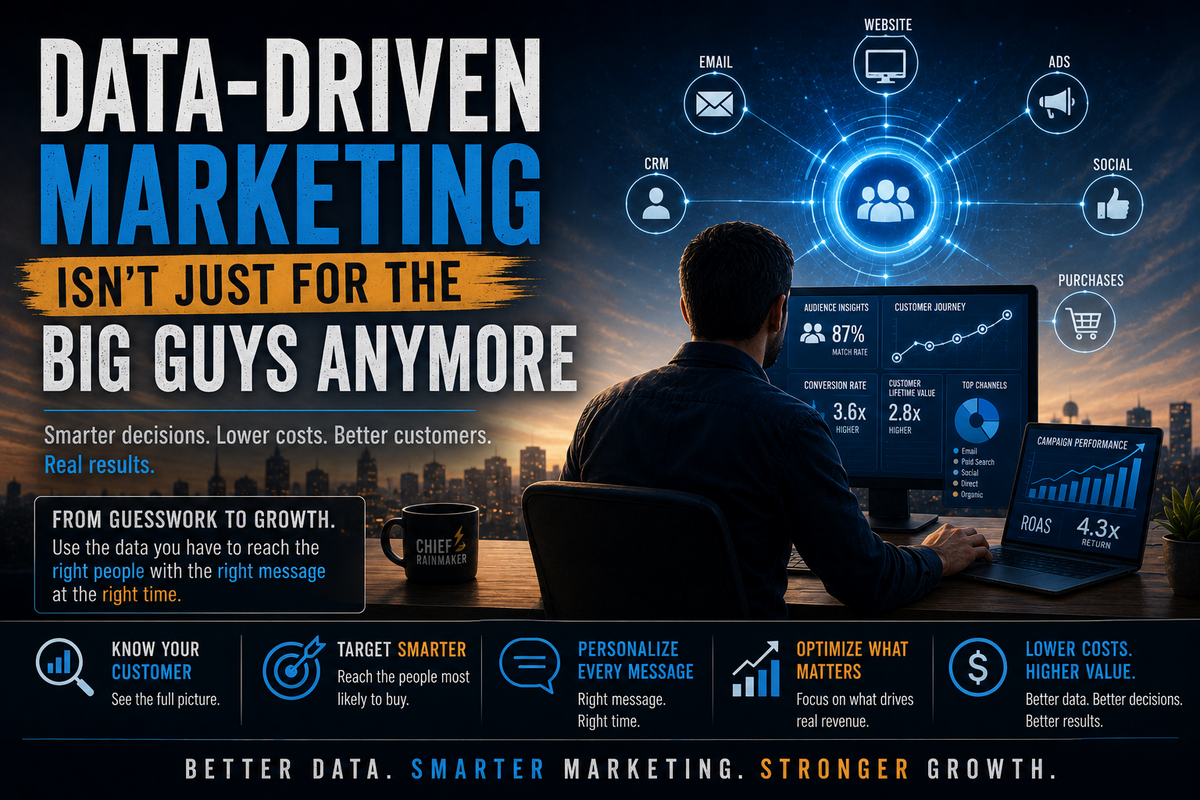
Data-driven marketing has become accessible to small businesses, no longer requiring extensive resources or expertise. The core idea is to use existing customer data to make informed marketing decisions, moving away from broad, impersonal strategies. By leveraging tools like website analytics, email platforms, and CRM systems, businesses can personalize campaigns, optimize spending, and improve customer engagement. The focus should be on understanding and utilizing current data before investing in new tools, ensuring that marketing efforts are efficient and targeted. Ultimately, the key advantage lies in understanding customers better than competitors, enabling more effective communication and sustained growth.
This isn't that version.
Here's the actual thing worth saying: data-driven marketing used to require a data engineering team, a six-figure analytics budget, and an enterprise contract with someone who wore fleece vests to investor meetings. That's no longer true. The tools that were genuinely out of reach for small businesses five years ago are now accessible, affordable, and in some cases free.
What hasn't changed is the underlying logic — and the underlying logic is worth understanding before you touch a single tool.
What Data-Driven Marketing Actually Means
Strip away the jargon and it's a simple idea: use what you already know about your customers to make better decisions about how you reach them.
Not spaghetti-and-wall. Not gut instinct dressed up as strategy. Not "let's try this because someone on a podcast said it was working for them."
Actual information. Applied to actual decisions.
The fax machine era of marketing — buy a list, blast it, count responses, repeat — operated on almost no customer intelligence. You knew a demographic approximation and a zip code. That was it. You were broadcasting to a crowd and hoping the right people happened to be in it.
Data-driven marketing inverts that. Instead of broadcasting and hoping, you identify, understand, and reach specific people based on what they've actually done — what they clicked, what they bought, what they came back for, what they abandoned, what they searched before they found you.
The difference between those two approaches, in terms of campaign efficiency and acquisition cost, is not small.
The Data You Already Have Is More Valuable Than You Think
Most small businesses are sitting on a surprising amount of useful data and not doing much with it.
Your website analytics tell you which pages people visit, how long they stay, where they came from, and where they go next. If a significant percentage of visitors are dropping off a specific page, that's not a mystery — that's a signal with a fixable root cause.
Your email platform knows who opens, who clicks, who buys, and who goes cold. Those behavioral segments are the raw material for campaigns that speak to each group differently instead of sending the same message to everyone and wondering why conversion rates are flat.
Your CRM holds purchase history, customer lifetime value, and the behavioral patterns that separate your best customers from your occasional ones. That information can tell you more about who to target next than any third-party data you could buy.
Your social media analytics show what resonates and what doesn't — not based on aesthetics or what you think is clever, but based on what your actual audience actually engages with.
None of this requires a data scientist. It requires paying attention to what the systems you're already using are already telling you.
The Insight That Changes How You Spend
Here's where data-driven marketing moves from interesting to financially meaningful.
When you know which channel produces your best customers — not just your most leads, but your highest-value, longest-retained customers — you can shift spend accordingly. The channel that looks expensive on a cost-per-lead basis might look cheap on a cost-per-customer basis. The channel that looks efficient up front might be producing customers who churn at twice the rate.
Without data connecting acquisition channel to customer behavior over time, you're optimizing for the wrong number.
The same principle applies at the campaign level. Two ads can have identical click-through rates and wildly different conversion rates — because clicks don't always mean what you think they mean, and the audience that clicks isn't always the audience that buys. Data closes that loop. It tells you which path actually leads somewhere.
This is where small businesses tend to leave the most money on the table — not because they're running bad campaigns, but because they're measuring the wrong things and optimizing for metrics that feel good but don't correlate with revenue.
Personalization Is Not a Luxury Feature
At scale, personalization sounds like an enterprise capability. In practice, even basic segmentation produces meaningfully better results than treating everyone the same.
A clothing retailer sending the same email to a customer who consistently buys athletic gear and a customer who consistently buys formal wear is leaving engagement — and sales — on the table. Those two people don't have the same next purchase. The data knows that. The email sequence should reflect it.
A service business that follows up differently with a new lead versus a dormant customer versus someone who just hit a pricing page for the third time this week will outperform one that sends the same follow-up sequence to everyone — because the context is different for each person and the message should be too.
This doesn't require sophisticated technology. It requires using the behavioral information you already have to segment your audience into groups with meaningfully different needs and sending each group a message that addresses their actual situation.
The bar here is genuinely low. Most businesses don't do even basic segmentation. Which means doing it at all puts you ahead of most of your competition.
The Tool Stack Reality Check
There's a version of this conversation that leads to a shopping list of software. That's not the most useful framing.
The most useful framing is: start with what you have, understand what it's telling you, act on the signal, and add tools only when you've outgrown the capability you already have.
Google Analytics — free, already installed on most sites — will tell you more about your website performance than most small businesses are currently using it for. Your email platform's built-in reporting tells you more about your audience than most businesses bother to read. Your CRM, if you're using one, is probably underutilized by a wide margin.
The pattern that tends to produce bad outcomes is buying more tools before extracting the value from existing ones. A CRM nobody updates is less useful than a spreadsheet somebody maintains. A CDP that hasn't been properly configured is less useful than a well-segmented email list.
Start by getting value from what you have. Then add capability as specific gaps become clear. Tools don't produce insight — attention to the data does.
One framework worth keeping in mind: your CRM and your CDP serve different purposes and the data flows one direction. Your CRM manages relationships and sales pipeline — individual customer records, interactions, deals. Your CDP aggregates behavioral data from multiple sources into unified customer profiles for marketing activation. CRM data should feed into your CDP. The reverse creates a mess.
Identity: The Layer That Makes Everything Else Better
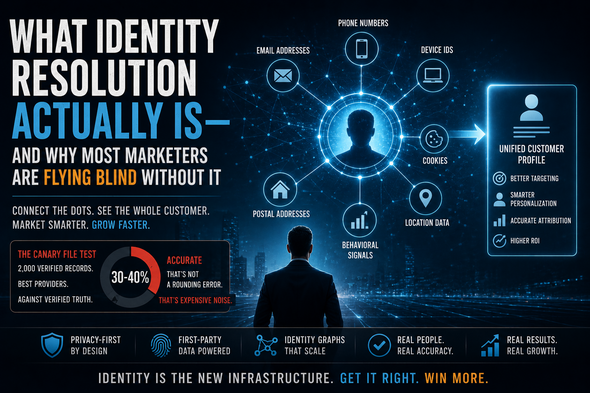
One concept worth understanding as your data sophistication grows is identity resolution — the process of connecting fragmented data points to a single unified customer profile.
Someone who clicks an email, visits your website from a different browser, and eventually calls your sales line is one person. Without identity resolution, they look like three separate contacts. With it, you see a single customer at a specific stage of a buying cycle, and every touchpoint becomes part of a coherent picture instead of isolated events.
At the small business level, this starts with something as basic as ensuring your email, CRM, and ad platform are sharing information about the same people — so that when a lead converts to a customer, your retargeting ads stop treating them like a prospect. That one step alone eliminates a surprisingly common and expensive problem: continuing to spend acquisition budget reaching people who already bought.
As the data infrastructure gets more sophisticated, identity resolution scales with it — connecting website behavior to email engagement to paid media to in-store purchases into a single view of the customer journey. But even at its simplest, the principle applies: know who you're talking to across every channel, and let that knowledge shape every message.
The One Thing That Doesn't Change
Every technology changes. The platforms shift. The tools get replaced. The targeting options get restricted and rebuilt. Privacy regulations reshape what data can be collected and how.
The one thing that doesn't change: understanding your customer better than your competitors do is a durable advantage.
Data is the mechanism for building that understanding systematically, at scale, without relying on intuition that doesn't transfer and anecdotes that don't generalize.
The businesses that compound over time aren't the ones with the biggest ad budgets. They're the ones that know their customers well enough to reach the right people with the right message at the right moment — and get better at it with every campaign they run.
That's what data-driven marketing is actually for.
Gil Ortega
The Chief Rainmaker
When You Want Rain
Gil Ortega is the founder of Profit Worldwide, Inc. and the creator of the Chief Rainmaker brand — a San Diego-based marketing strategist focused on customer acquisition, audience engineering, and AI-powered growth systems. He is the author of Give Value Sell Results: Building Predictable Outcome Systems in the Age of AI.
Read more at ChiefRainmaker.com